Improve the margins behindevery AI workflow.Improve the marginsbehind every AI workflow.
See exactly what every customer, workflow and AI feature costs, control spend before it happens, and put your AI budget where it matters.
Get an immediate score across attribution, enforcement, containment, margin visibility, and reconciliation.
One layer between
your apps and every
model you use.
Spendline sits in the request path, attributing, governing, optimizing and reconciling every call before it reaches a provider.
- 01 Attribute
Know what you are spending it on
Every AI cost mapped to the customer, agent, workflow, feature, team, or cost centre behind it, not just a monthly total.
- 02 Govern
Keep spend inside the budget
Set budgets by organisation, team, agent, or customer and hold spend to them automatically. A limit can raise an alert, require an approval, or stop the request before the money is spent.
- 03 Reconcile
See the margin on each customer
Where revenue data is available, set AI cost against revenue per customer so you can see where AI usage is supporting margin and where costs need attention.
AI costs are created inside product flows.
Finance only sees the total after the fact.
Every prompt and tool call is a spend decision, made by code, not a person, thousands of times a day. Provider dashboards show the total. They do not show which customer or feature caused it.
Which customers are actually profitable after AI costs? Most teams cannot answer this.
During investment diligence, we observed an anonymous company generating approximately $32M in revenue while spending approximately $39M on purchased AI services with no meaningful attribution.
Engineers saw tokens. Finance saw invoices. The board saw the gap too late. No one could connect the cost to the customers, teams, or workflows that created it.
Attribution runs in the request, not in the report.
Once your customer, workflow, and team labels are attached, every request is mapped to whatever caused the cost, the moment it happens.
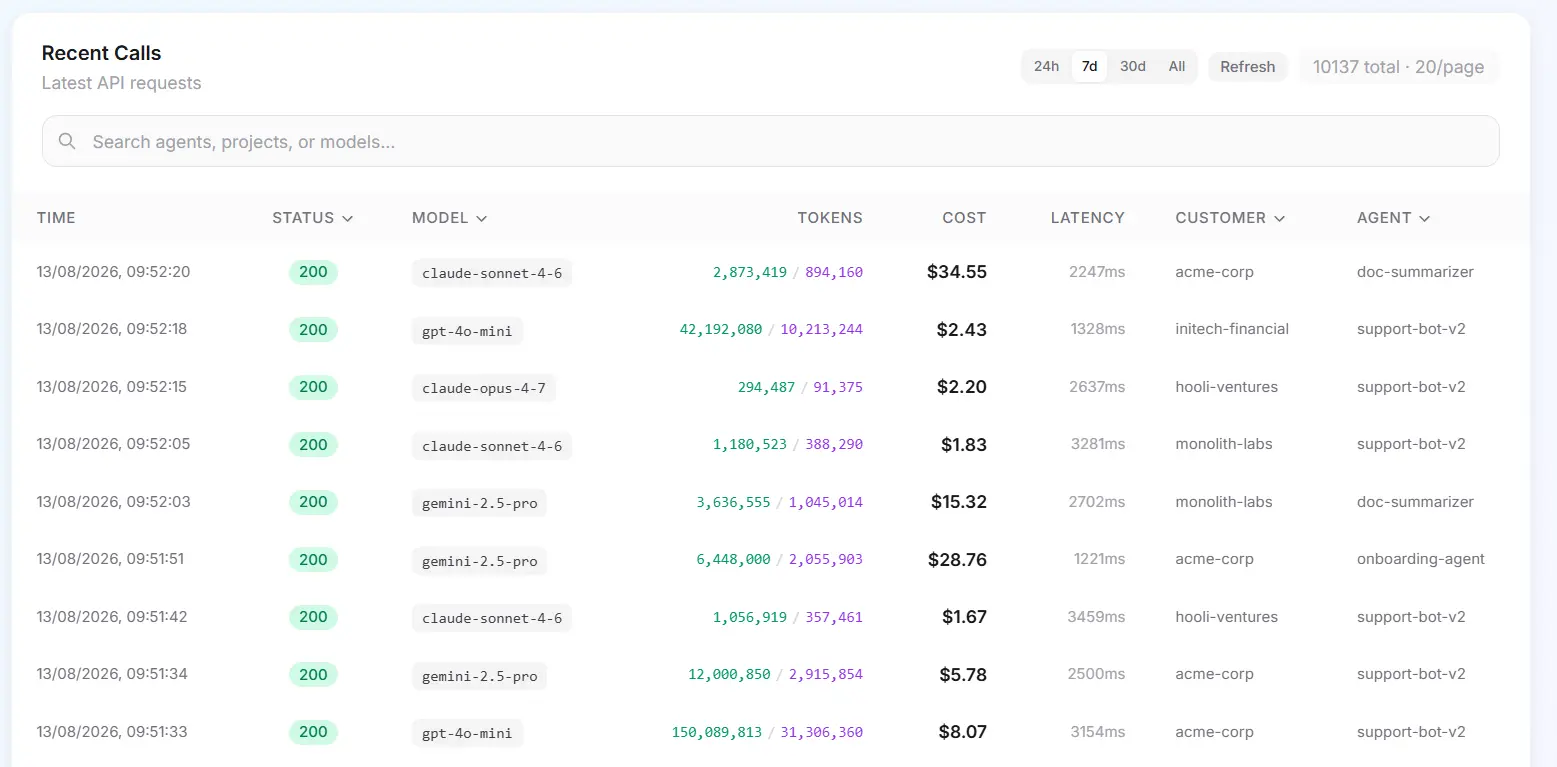
Every call, attributed the instant it happens
Provider dashboards show one total. They can't tell you which customer, agent, or workflow actually caused a given call, so the number is unusable for anything but a top-level sanity check.
10,137 calls this week alone, each one tied to the exact model, customer, and agent that made it, the moment the request happens, not reconstructed later from logs.
Figures are illustrative, from a sample account, not a real customer.
Every buyer arrives with a different question.
Spendline answers all three from the same ledger.
“What did AI actually cost per customer last month?”
Cost per customer, per agent, per workflow, attributed the moment it happens and compared against revenue.
“What’s routing through what, under what controls?”
Every model, agent, and workflow visible in one place, with budgets and policy enforced in the request path.
“Can we close the month?”
An append-only ledger with every dollar attributed, so the books close because the data was clean on the way in.
How controlled is your AI spend?
The Spendline assessment evaluates six areas. It produces an immediate score and identifies the controls that are missing.
- 01AttributionPer-customer and per-workflow cost attribution
- 02Central controlAll AI traffic through one managed control point
- 03EnforcementRequest-path budgets with override approvals
- 04ContainmentRunaway detection with same-day containment
- 05Margin and allocationPer-customer margin and cost-centre allocation
- 06ReconciliationMonth close and invoice reconciliation
Integrate in a few clicks
One small setting change wherever your app currently calls a model provider, nothing else to rewrite or redeploy. Works with the OpenAI, Anthropic, and every other client library you already have installed.
import OpenAI from "openai";

const client = new OpenAI({
  apiKey: process.env.OPENAI_API_KEY,
  baseURL: "https://www.spendline.ai/v1",
  defaultHeaders: {
    "x-spendline-key": process.env.SPENDLINE_API_KEY,
    "x-agent-id": "support-bot",
    "x-customer-id": customerId,
  },
});
Helicone, Langfuse, and LiteLLM show tokens. Spendline shows the margin left after AI cost, per customer.
Those tools report what already happened. Spendline acts in the request path: attributing, enforcing, and applying policy before the cost is incurred. Engineering installs it for visibility; finance adopts it for control.
| Customer | Margin |
|---|---|
| Brightline SaaS | 91% |
| globex-data | 74% |
| Northline Robotics | 42% |
Value-linked.
Not seat-based.
Priced as a base fee plus a capped percentage of AI spend under management, not seats, because AI workloads don't map to seats.
- In-path proxy with attribution
- Real-time cost dashboard
- Hierarchical budgets (org, team, agent)
- Policy engine with budget guardrails and spend alerts
- Anomaly detection and alerts
- 60-day free pilot to start
- Everything in Growth
- Customer margin analytics
- Cost optimizer with reroute rules
- AI month close workflow
- Budget override approval flows
- Slack, Discord, webhook alerts
- Everything in Platform
- SSO and identity integration
- Private deployment architecture
- Finance-system exports and integrations
- Custom approval workflows
- Dedicated implementation support
Customers move to Enterprise for deployment, compliance, and workflow features, not because spend crossed a threshold. Available through scoped pilot agreements.
Understand your AI cost structure
from the first request.
One small setting change, no commitment, and you'll see your real AI cost breakdown today.
Not ready yet? Take the free assessment →, no credit card, no signup required.